10–20 October 2026
My Rajasthan Diaries
Eleven days through forts, frescoes, temples, desert skies and stories.
Our route
- Bengaluru
- Jaipur
- Mandawa
- Pushkar
- Bikaner
- Jaisalmer
- Khuri dunes
- Jodhpur
- Ranakpur
- Kumbhalgarh
- Nathdwara
- Udaipur
- Bengaluru
This is a personal account, not a sponsored guide. Experiences and prices refer to October 2026; verify access, hours and costs before travelling.
This is not a catalogue of monuments or a list of places to tick off. It is the story of a long-awaited journey, seen through my interest in history, architecture, paintings, crafts, and the everyday details that make travel personal. I have included background about the places we visited, but the impressions, preferences and occasional disappointments are my own. When I repeat a particular story told by a guide, I identify it as such.
The journey before the journey
Rajasthan had been on my mind for more than ten years. We had travelled widely in India, particularly to sacred places: together, we had visited many important pilgrimage sites across India. Pilgrimage taught us to travel with patience and curiosity, but my Rajasthan wish was also about something else: forts, museums, frescoes, carved wood, miniature paintings and the lives behind them.
Whenever I admired a beautifully carved wooden object at an exhibition or in a shop, I would ask where it came from. So often the answer was Jaipur, or somewhere in Rajasthan. Every such conversation added another reason to go. I wanted to see the crafts at their source, meet the people making them and understand the traditions behind the objects.
And then there was Maharana Pratap. As a child, I listened to my teacher narrate stories about his courage and about Chetak, his loyal horse. Those stories stayed with me. Long before I saw Rajasthan on a map, it existed in my imagination as a place of extraordinary courage and character.
I finally made this journey with my husband. He is not simply the person who travelled beside me. He is my favourite travelling companion. We had eleven days to explore, to stop for pictures, to disagree occasionally about how much more we could fit into a day, and to bring home memories that would last far longer than the holiday.
Day 1, Saturday 10 October
Jaipur: first impressions of the Pink City
An ordinary airport, an extraordinary old city, and an artistic welcome.
We began while Bengaluru was still asleep. Our flight left at 1:10 in the morning, and after a connection through Ahmedabad we reached Jaipur on the early morning flight. I had waited more than a decade to come to Rajasthan, so perhaps my expectations were unusually high. Even the airport, I imagined, might greet visitors with a hint of the state’s royal heritage. Instead it felt rather ordinary — and the heat was immediate. It was not quite the grand welcome I had pictured!
We stayed at Arya Niwas, conveniently placed for exploring the old city. That choice worked beautifully: it was an economical, comfortable base, and we could reach the main sights without making every outing a major expedition. What caught my attention first, though, was not the convenience. It was the Mithila artwork on the walls. I practise and admire traditional Indian art, so seeing familiar motifs in a Jaipur hotel was an unexpected pleasure. One long painting, around five metres wide, was especially striking. Breakfast had another memorable detail: live sitar music. It was a lovely way to begin a day of sightseeing.
Why “pink” when I see terracotta?
After freshening up, we entered the old walled city. Suddenly the Jaipur I had imagined began to appear. Buildings stretched along the streets in a coordinated terracotta shade. Shop signs followed a similar visual pattern. Amid the bustle of traffic and commerce, there was an astonishing sense of uniformity. I kept looking from one building to the next, wondering how a living, busy city had retained such a distinct visual identity.
I asked our guide a question that had been bothering me: why call it the Pink City when the colour looked terracotta? Jaipur’s buildings were famously painted for the 1876 visit of the Prince of Wales, later King Edward VII, with pink associated with hospitality. Our guide added an anecdote: that the visiting prince described the terracotta shade as pink and the description stayed. I enjoyed that explanation, although I treat that particular detail as the guide’s telling rather than a settled historical fact. Whatever the precise origin of the nickname, the city’s colour was unforgettable.
Four landmarks, four different stories
At City Palace we stepped into the history of Jaipur’s rulers and their taste for courtyards, ornament and ceremonial spaces. Jaipur itself was founded in 1727 by Sawai Jai Singh II, and the city’s planned layout is part of what makes it remarkable. Its historic walled city is recognised by UNESCO.
Jantar Mantar offered a very different kind of wonder. Here, enormous instruments of stone and masonry were built to observe the heavens and measure time. The site is a reminder that the ruler who founded Jaipur was deeply interested in astronomy. At Hawa Mahal, the honeycomb façade and rows of small windows showed another side of architecture: a building that is instantly recognisable, yet designed around climate, privacy and courtly life. Jal Mahal, appearing to float in Man Sagar Lake, gave us a quieter scene to look at.
I liked all four places. Rather than selecting one as the winner, I enjoyed how different they were. By evening we had also seen the shops and markets of the Pink City. What stayed with me was not just the list of monuments, but the colour of the streets, the consistency of the signboards, the artwork at our hotel and the music over breakfast. Rajasthan was beginning to feel like a place where history and art could appear at any moment, even between the major attractions.
Day 2, Sunday 11 October
Jaipur: forts and a childhood memory
Amer, Jaigarh, Nahargarh and the stepwell that brought back Sirivennela.
Our second day in Jaipur was devoted to its hill forts and a stepwell that had a special place in my imagination. The forts around Jaipur are more than scenic viewpoints; together they help explain how royal residences, military defence and the surrounding landscape once fitted into a single system.
Amer: grandeur in layers
Amer Fort rises above the town of Amer, its pale walls and gateways following the contours of the hills. Its courtyards lead from public spaces into increasingly private royal areas. Ganesh Pol, with its elaborate decoration, is among the features that reward a closer look. Sheesh Mahal, associated with intricate mirror work, shows how reflective surfaces can transform a room with light. I found myself thinking not only about the kings and queens who lived here, but about the artists and craftspeople who spent so much time on each detail.
Amer is also a reminder that Rajasthan’s architecture is never just one style. Rajput traditions, Mughal influences, practical responses to heat and the demands of court life all appear in different parts of the complex. For anyone who loves visual detail, it is worth slowing down rather than hurrying from one photo spot to another.
Jaigarh and Nahargarh: another view of Jaipur
Jaigarh, positioned above Amer, was associated with the defence of the region. Its ramparts, commanding views and the famous Jaivana cannon tell a story quite different from the decorated chambers below. A fort built for protection has its own kind of beauty: thick walls, strategic positions and the feeling of the landscape opening out around you.
Nahargarh, overlooking Jaipur, completed our circuit. From the hills, the planned city becomes easier to appreciate as a whole. It is one thing to walk through a street lined with terracotta buildings and quite another to look down towards the city from above. Each fort had a different personality, and together they made the day memorable.
Panna Meena ka Kund: a memory from childhood
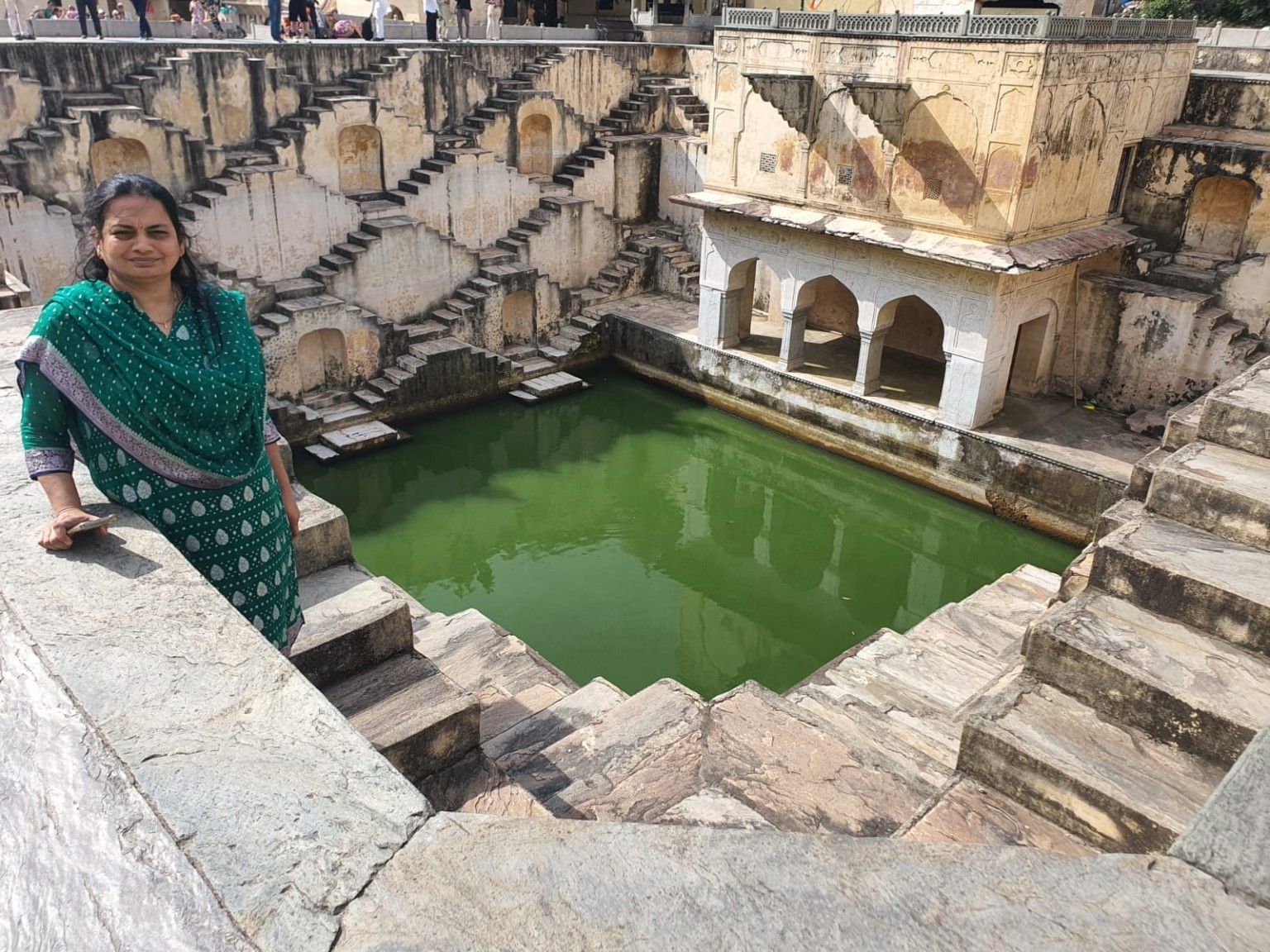
The place that carried a particularly personal meaning for me was Panna Meena ka Kund, the old stepwell near Amer. As a child, I had watched the Telugu film Sirivennela and remembered a song featuring a beautiful stepwell. That image stayed with me for years. I wanted, someday, to stand beside a place like it and take photographs.
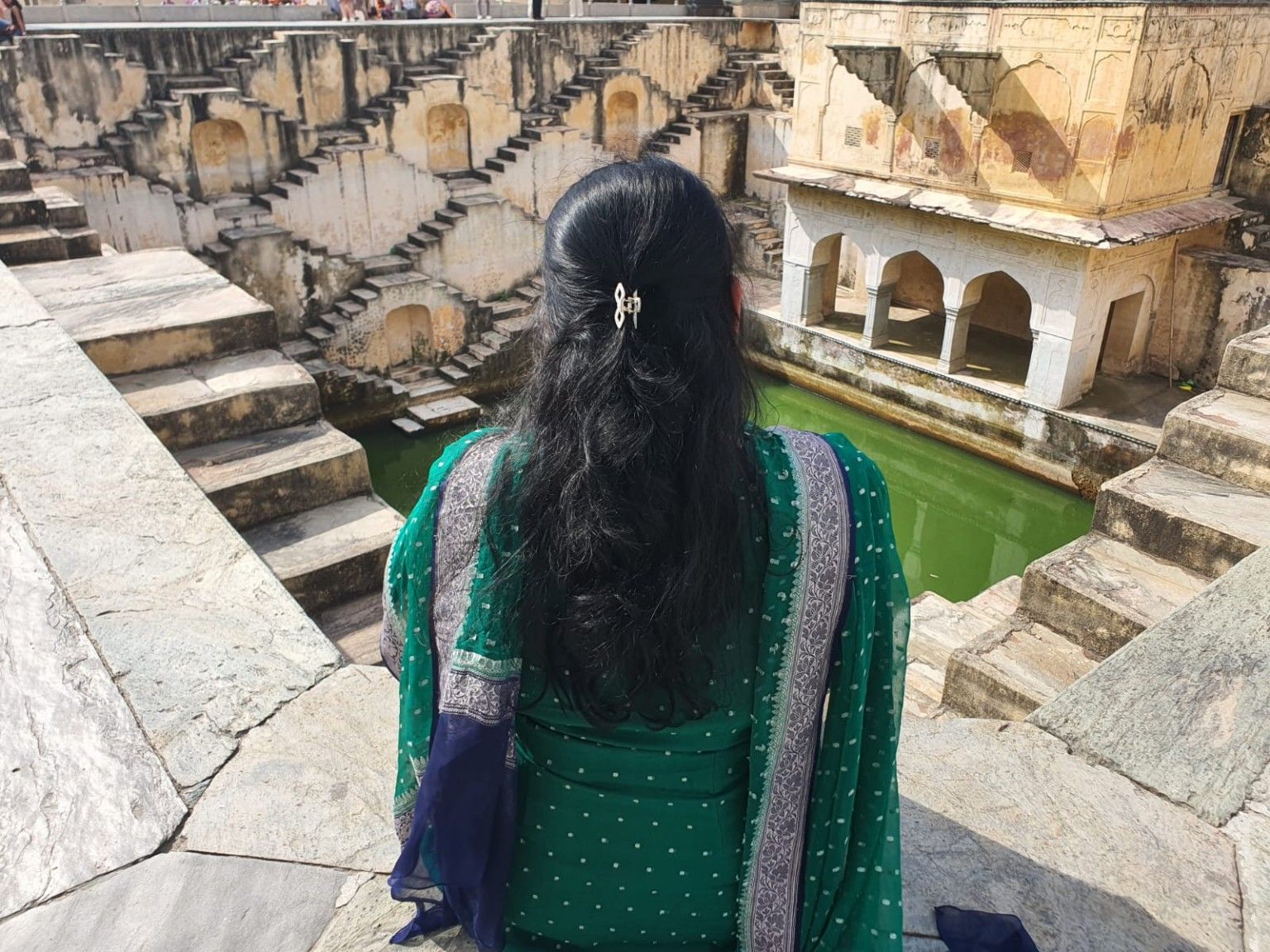
Panna Meena ka Kund is not the actual stepwell shown in the film. But its geometry — repeated flights of steps descending in carefully arranged patterns — brought that old memory back. Stepwells were practical water structures, especially important in regions where storing and accessing water mattered enormously. Yet their symmetry also makes them visually captivating. Looking at those steps, I was seeing both an example of traditional engineering and a small piece of my own childhood imagination.
Travelling often does this: a place becomes meaningful not only because of its history, but because of something we have carried within us for years. That was my connection to this stepwell. After a day of impressive forts, it was a quieter, more personal memory to take away.
Day 3, Monday 12 October
Mandawa: painted walls and a dream haveli
Six havelis, countless frescoes, and one entirely reasonable request to Prem.
We left Jaipur and travelled towards Mandawa in the Shekhawati region. If Jaipur had impressed me with its planned streets and royal architecture, Mandawa was about the art of the home — and about the extraordinary ambitions of merchant families who commissioned buildings that still astonish visitors.
Why Shekhawati is a painted world
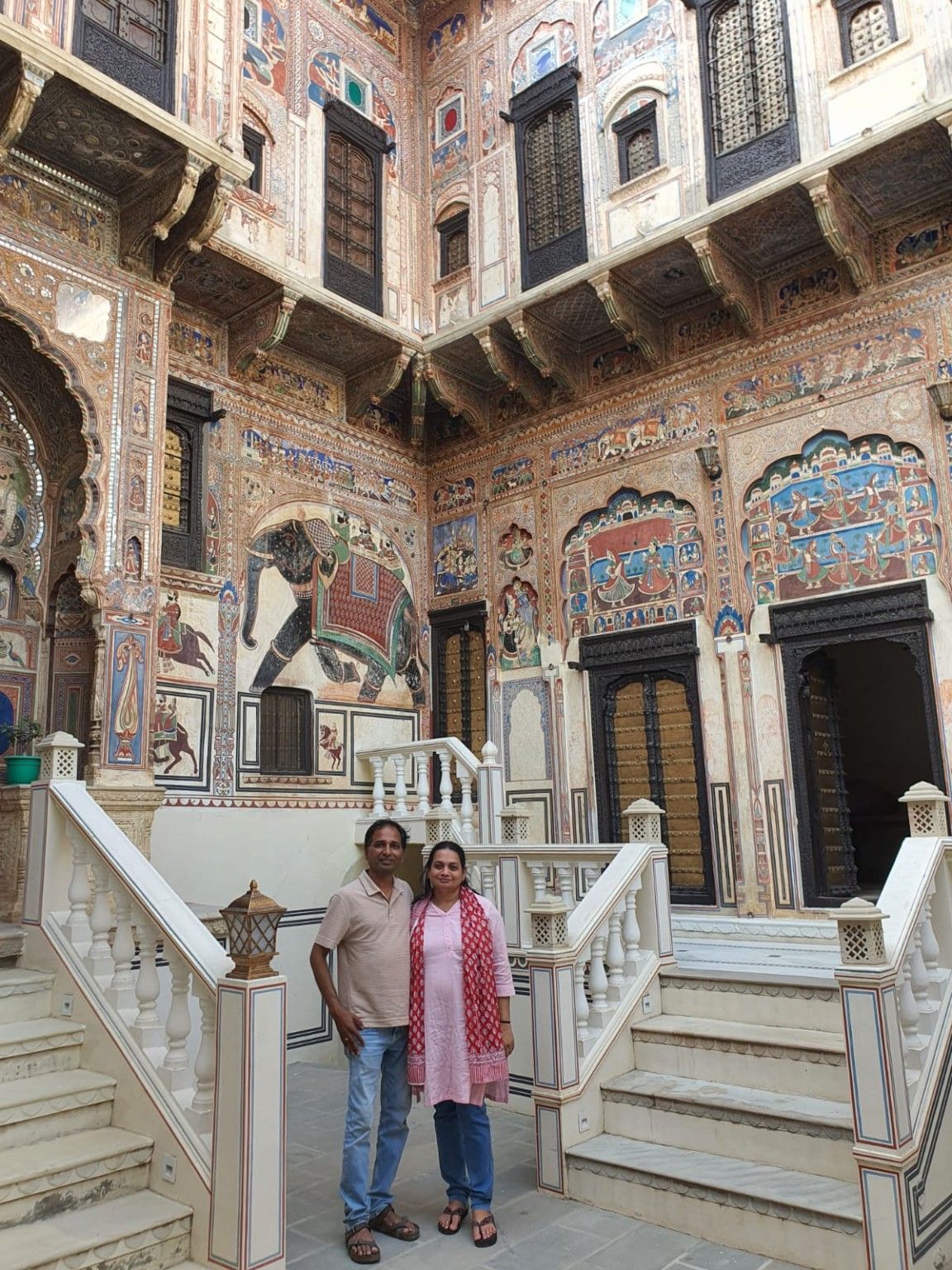
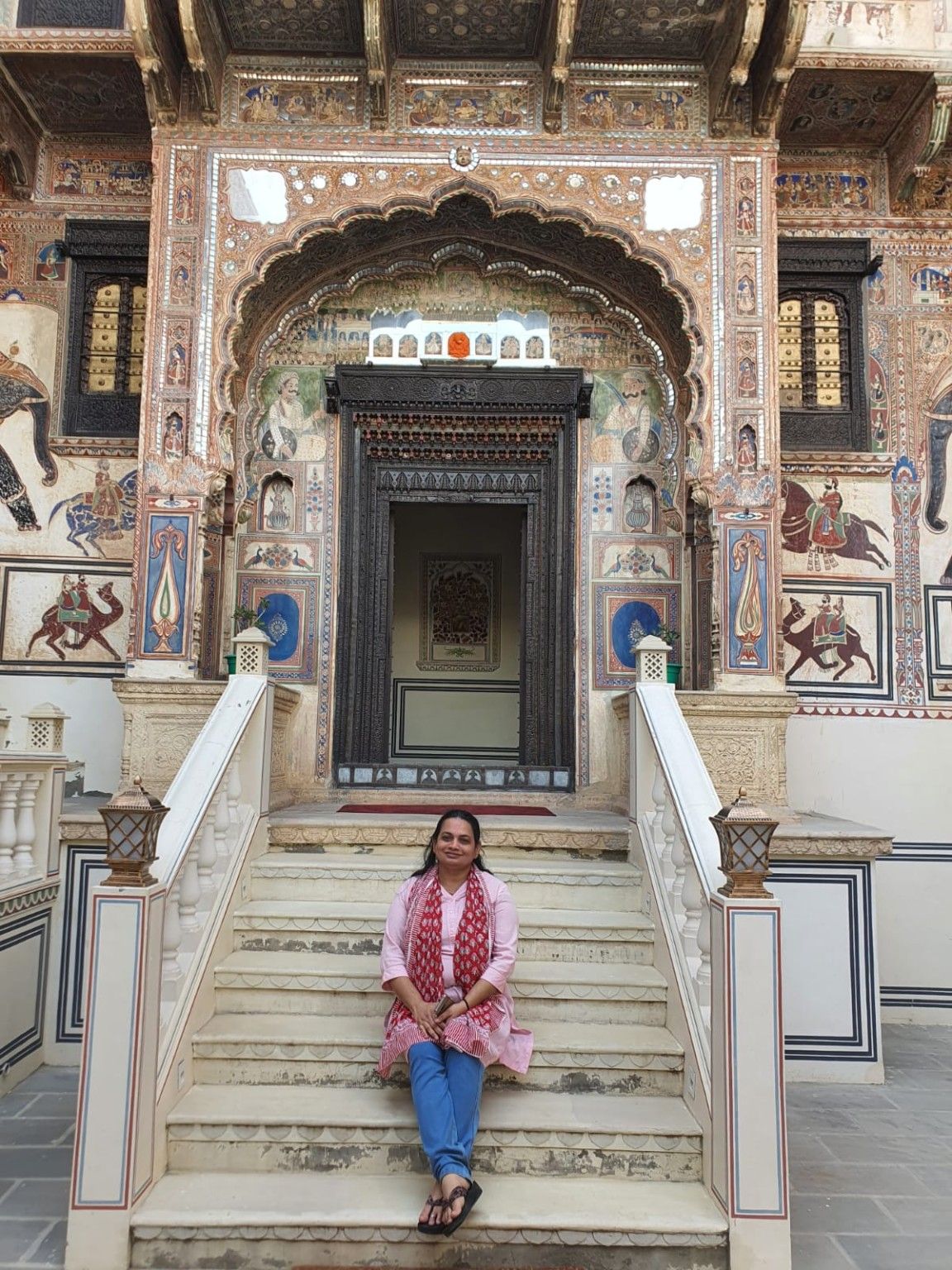
The towns of Shekhawati became prosperous through trade and merchant networks. Wealthy families built grand havelis, often arranged around courtyards, with elaborately decorated entrances, rooms and façades. Their walls became painted surfaces. Frescoes and murals depict deities, mythological episodes, everyday scenes, flowers, animals and, in some places, images inspired by changing fashions and modern technology. Walking through them feels rather like turning the pages of a vast illustrated book.
We visited six havelis. Everywhere I looked there was something to photograph: painted ceilings, carved wooden doors, elephant motifs, delicate borders, courtyards, gateways and fading yet beautiful scenes on plaster. Some paintings had weathered with time; others still carried strong colour. The combination of art and architecture was extraordinary. I found myself wondering what everyday life must have been like inside these homes, when their courtyards were full of people and their walls newly painted.
The haveli I wanted to take home
At some point, surrounded by all that beauty, I asked Prem to buy me a haveli. It was said with a smile, of course — but only partly as a joke! I could easily imagine spending even one day in a home like that, surrounded by frescoes, old wooden doors and courtyards filled with stories. Prem has patiently photographed so many things that catch my eye; this time, I was mentally planning an entire future haveli.
One particularly happy surprise was seeing framed Mithila or Madhubani-style artwork in a haveli. As someone who loves that tradition, I noticed it immediately. My eye kept returning to the familiar rhythms of lines, birds, trees and decorative patterns. Rajasthan’s painted walls were offering me new ideas, but also making me feel connected to the art I already knew.
For readers who visit Mandawa, I would recommend taking time to look beyond the largest murals. Study the edges of doorways, the smaller motifs around windows and the way the painting relates to the architecture. That is where some of the loveliest details live. These are historic homes and fragile artworks, so respectful visiting matters.
A late arrival in Pushkar
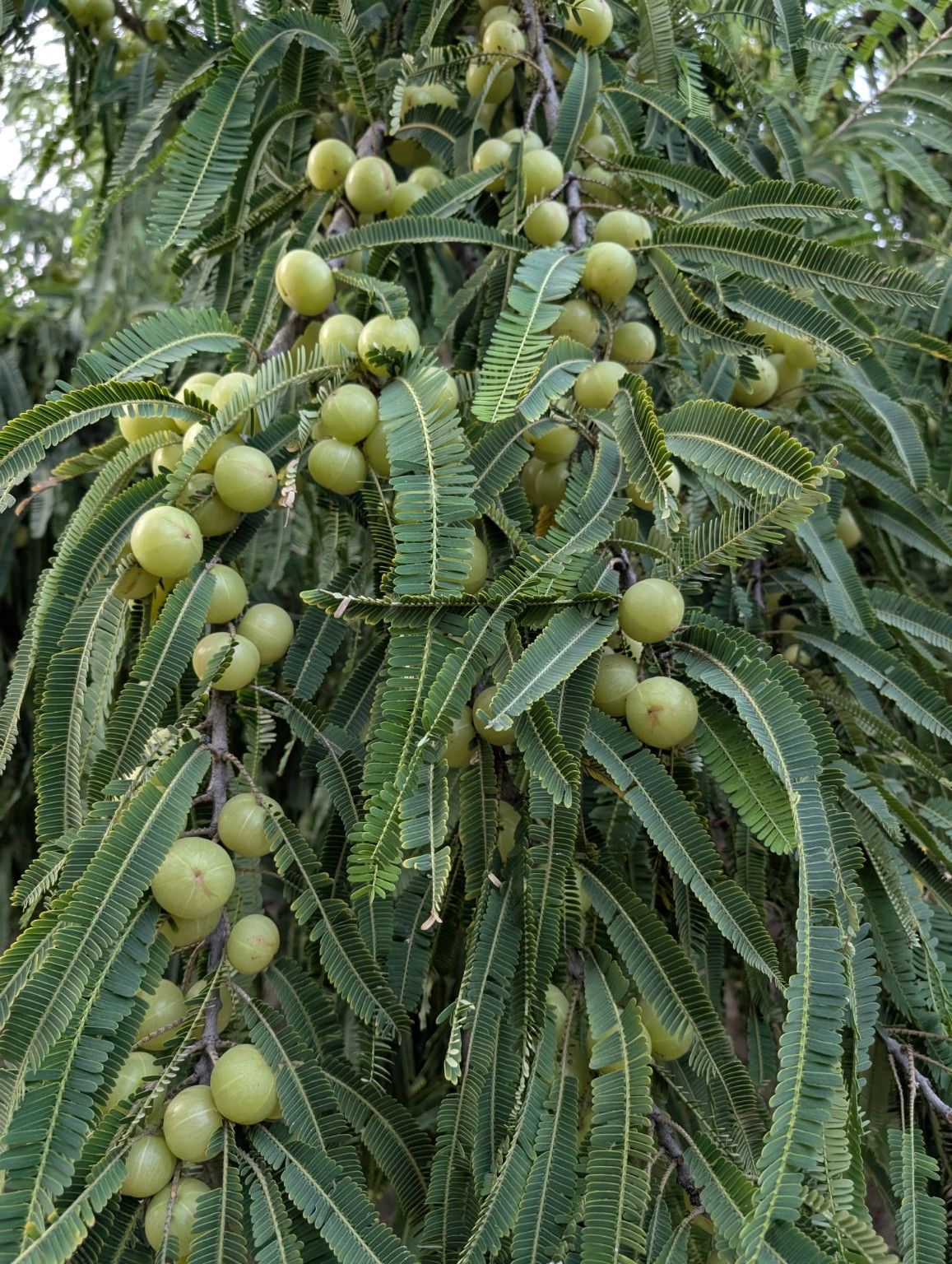
By night we reached Pushkar, around 9:30 p.m., and checked into Athithi Resort. After the visual abundance of Mandawa, the property felt calm and green. There were cottage-style rooms, a veranda and amla trees carrying plenty of fruit. Traditional Rajasthani wall scenes added to the atmosphere. The following morning, with breakfast and a little time to notice the surroundings, the resort became more than just an overnight stop. It was another reminder that sometimes a hotel is memorable for one small detail — in this case, those amla trees.
Day 4, Tuesday 13 October
Pushkar to Bikaner: temples, camels and a princess
A sacred lake, a royal fort and an encounter we never planned.
Pushkar has a very different atmosphere from the fortified cities we had been exploring. Its identity is closely tied to pilgrimage, to the sacred lake and to the rare, well-known Brahma Temple. We visited the temple and the ghats around Pushkar Lake, where the steps and water form the centre of the town’s spiritual life. We also went to Savitri Mata Temple using the ropeway, which gave us another perspective on the surrounding landscape.
We continued towards Bikaner, stopping for lunch on the way, and arrived around 2 p.m. Our day there combined two worlds that might seem unrelated at first: the desert’s relationship with camels and the lavish decorative traditions of a royal court.
Camels and the desert economy
At the National Research Centre on Camel, we encountered an animal that has been central to life and transport in arid Rajasthan. Camels are often presented to tourists as picturesque silhouettes against dunes, but their importance runs much deeper: mobility, livelihoods, milk, adaptation and research. It was interesting to see that side of the region before moving on to the city’s royal monuments.
Junagarh: the palace of details
Junagarh Fort is especially notable because, unlike many famous Rajasthani forts, it stands on relatively level ground rather than high on a hill. Inside are richly decorated palace spaces, painted ceilings, carved doors, mirrors and elaborate ornament. We visited the fort and the Prachina Gallery. I loved the details: floral patterns, painted surfaces, decorative rooms, and doors with Radha and Krishna imagery. I kept finding new things to look at. There was so much craftsmanship concentrated in one place that it was difficult to know where to point the camera next.
It is tempting to describe palaces only in terms of kings, battles and dates. But for me the deeper fascination lies in the hands that made them: painters, woodcarvers, stoneworkers, mirror specialists and generations of artisans whose work outlived them. Junagarh made that thought especially vivid.
Coffee, a conversation and an unexpected photograph
After exploring the palace and gallery, we were tired. We stopped at the palace café for water and coffee. A woman was seated nearby, speaking with someone. I overheard the word “princess” and became curious. When I asked the café staff, I learned that she was a member of Bikaner’s former royal family and a public representative who had been elected to the Rajasthan Legislative Assembly.
I approached her, greeted her and asked whether we could take a photograph. I also asked if I could share it on social media. Her response was warm and simple: “Absolutely!” What had started as a short break for coffee turned into one of the unexpected memories of our journey. I was glad I had asked rather than simply wondering who she was after we left.
We stayed that night at Harasar Haveli. By then, Rajasthan had already given us temples, painted merchant homes, grand forts and a spontaneous meeting with someone connected to its living royal history. The trip was becoming wonderfully varied.
Day 5, Wednesday 14 October
Jaisalmer: sunset among the cenotaphs
From Bikaner to the Golden City, arriving just in time for evening light.
We travelled onward to Jaisalmer, a city whose identity is inseparable from the golden-yellow sandstone used in its buildings. As the sun changes position, the stone seems to change colour too. That is part of the reason Jaisalmer is so often called the Golden City. Its location also recalls the caravan routes and trade networks that once connected desert settlements with distant markets.
Bada Bagh at six
We reached Bada Bagh at around 6 p.m. and watched the sunset. The site is known for its royal cenotaphs — memorial structures whose domes and columns make a striking pattern against the desert landscape. The low evening light suited the stone beautifully. After a long road journey, it was a memorable way to enter the Jaisalmer part of our trip: not through a busy market or a hotel lobby, but through a quiet landscape of memorial architecture and sunset.
We checked into Heritage Inn afterwards. Not every hotel on a long journey becomes a favourite, and this one was not among our best stays. I think it is worth saying so. Travel diaries should include the ordinary disappointments as well as the grand sights; otherwise every day begins to sound suspiciously perfect.
Jaisalmer still had much more waiting for us. The following day would bring carved havelis, a living fort, a reunion with a friend and, finally, the desert itself.
Day 6, Thursday 15 October
Jaisalmer and Khuri: a day of many worlds
Stone-carved mansions, a friend’s welcome and a night beneath the stars.
Our day in Jaisalmer moved through remarkably different settings. We explored the fort, the famous havelis and Gadisar Lake; met a friend; and ended the day among the dunes at Khuri. It is difficult to imagine a better example of how varied one day of travel can be.
A fort that is also a neighbourhood
Jaisalmer Fort, often called Sonar Quila or the Golden Fort, is remarkable because it remains a living settlement, not simply a monument preserved behind gates. Houses, shops and places of worship are part of its continuing story. Built in the twelfth century under Rawal Jaisal, the fort rises from the desert in warm sandstone. Walking through its lanes, one can see how history remains part of everyday life.
We also visited Jaisalmer’s famous havelis. Patwon Ki Haveli, Nathmal Ki Haveli and other historic mansions show what skilled stoneworkers can do with sandstone: projecting balconies, latticed windows, finely carved façades and surfaces so intricate that they sometimes resemble lace. The carving especially fascinated me. After the painted plaster of Shekhawati, here was another medium carrying Rajasthan’s love of detail.
At Gadisar Lake, we saw another dimension of desert-city life. Historic water bodies were not merely scenic attractions; water collection and management were essential to the survival of settlements in this climate. It is easy to admire a lake’s reflection, but the history of how people secured water is equally important.
A visit with my friend
One of the happiest parts of the day was meeting a friend, who lives in Jaisalmer because her husband works with the Air Force. We had lunch at her home. After days of restaurants and hotel meals, spending time with a friend gave the journey a different kind of warmth. She also took us on a car tour during my first visit to an Air Force station. I will leave the details of the station private, but the experience itself was new and memorable for me.
It reminded me that travel is not always about famous places. Sometimes the most meaningful stop is a familiar face in an unfamiliar city.
Khuri: the desert after dark
From Jaisalmer we continued to Khuri dunes and Registhan Desert Camp. The day’s pace changed again. There was a desert safari, a camel ride, and an evening of local music and traditional dance. The performers brought a living cultural tradition into the camp, and I enjoyed seeing that side of Rajasthan after so many days of museums and historic buildings.
The food was not good, and we simply managed with what was available. But that was a small part of the night. The greater memory was sleeping in the desert and looking up at the moon and stars. Away from the cities, the sky seemed to become the main attraction. After the day’s stone carvings, roads and conversations, the quiet of the desert felt extraordinary.
It was one of those experiences I would happily remember without needing to improve it in the telling.
The meals could have been better. The night sky needed nothing.
Day 7, Friday 16 October
Jodhpur: the Blue City and royal comfort
Forts, marble, markets and a stay that felt truly special.
After the desert, we continued to Jodhpur, another city with a distinct identity. Jaipur is associated with pink, Jaisalmer with golden sandstone, and Jodhpur with the blue-painted houses visible in parts of its older neighbourhoods. The colours are useful labels, but each city is much richer than its nickname.
The fort above the city
Mehrangarh Fort dominates the skyline. Its towering walls and elevated position create a sense of scale that is difficult to capture in a photograph. Inside, the palace areas and museum collections reveal the ceremonial and artistic world of Marwar’s rulers. The views over Jodhpur are impressive, but the interiors deserve just as much attention. For me, Rajasthan’s forts were never only about defence; they were also repositories of craft and memory.
We also visited Jaswant Thada, the elegant marble memorial associated with Maharaja Jaswant Singh II. Its pale stone and quieter atmosphere contrast with Mehrangarh’s massive walls. Umaid Bhawan Palace brought us into a different era of royal architecture, with its twentieth-century design and distinctive scale. We covered the Clock Tower area and Sardar Market as well, seeing the busy commercial life of the old city alongside its grand monuments.
A hotel worth remembering
Our stay at Rohet Garh, in Rohet village, was among the best of the entire journey. It was clean, neat and beautifully maintained, and I loved the sense of Rajasthani royalty in the surroundings. If I were giving it a personal rating, it would be five stars. After a succession of very different hotels, this one stood out for its quality and atmosphere.
Jodhpur also reinforced something I had been noticing throughout Rajasthan: the extraordinary effort that has gone into preserving royal buildings, traditional architecture and cultural forms. Not everything about travel was perfect, but the heritage itself continued to impress me. All the places we visited in Jodhpur were enjoyable; the day was simply a very good one.
Day 8, Saturday 17 October
Ranakpur and Kumbhalgarh: stone, faith and memory
A marble temple and a hill fort connected to a childhood hero.
We travelled through the Aravalli landscape towards Ranakpur and Kumbhalgarh. By now, I had seen many kinds of Rajasthani architecture, yet these two places offered another contrast: a temple celebrated for its intricacy and a fort celebrated for its immense defensive setting.
Ranakpur: marble that seems almost weightless
Ranakpur Jain Temple is famous for its richly carved marble and its many pillars — traditionally described as 1,444, with intricate variations in their decoration. The temple complex is associated with the fifteenth century and is dedicated primarily to Adinatha, the first Jain Tirthankara. What fascinated me was the discipline behind the work: so much repetition, yet so much variation. Stone is a hard material, but in skilled hands it can seem delicate and light.
For someone who loves painting and pattern, Ranakpur offered a different lesson. Lines that I might draw with a pen or brush had been translated into carved stone. The details invite patience; there is far more to see than a quick glance can absorb.
Kumbhalgarh: the landscape of Maharana Pratap
Kumbhalgarh Fort is part of the historic hill-fort tradition of Rajasthan and is known for its extensive walls, often described as stretching for about 36 kilometres. It is also traditionally recognised as the birthplace of Maharana Pratap. For me, that association was meaningful. I had grown up hearing stories of his determination and of Chetak, the horse whose loyalty became legendary in popular retellings.
It is one thing to hear those stories as a child, and another to travel through the region connected to them. The hills and fortifications made the scale of the landscape easier to imagine. I do not want to invent a dramatic moment of emotion that I did not record at the time; it is enough to say that this was a place linked to a figure I had admired since childhood.
We stayed overnight at Kumbhalgarh Junagarh Resort. The following morning would take us towards Nathdwara, Eklingji and finally Udaipur.
Day 9, Sunday 18 October
Towards Udaipur: temples, gardens and an evening of culture
A day that began with devotion and ended in the old city.
We left Kumbhalgarh at about 7:30 in the morning and travelled towards Nathdwara. The first part of our day was devoted to two important temples, each deeply connected with Rajasthan’s religious and royal history.
Shrinathji and Eklingji
At Nathdwara we visited Shrinathji Temple, dedicated to a form of Krishna especially revered in the Pushtimarg tradition. The town is also associated with Pichwai paintings, devotional works that depict Shrinathji and seasonal or festival settings. That connection between worship and painting naturally interested me. In Rajasthan, art so often belongs not only in galleries, but also in the rhythms of devotion.
We then visited Eklingji Temple, associated with Lord Shiva and the historic rulers of Mewar. Eklingji’s significance goes beyond its architecture: the deity has traditionally been regarded as the spiritual sovereign of Mewar, with its rulers serving in a custodial role. After years of visiting sacred sites across India, it was meaningful to include these temples in our Rajasthan itinerary.
First impressions of Udaipur
We reached Udaipur around 2 p.m., had lunch and checked into Hotel Udaigarh in the old-city area near Lake Pichola. After so many days on the road, the city immediately felt different to me. Compared with many stretches we had travelled through, I found Udaipur cleaner and neater, with wider roads in the areas we saw. It would eventually become my favourite city of the trip.
We visited Saheliyon Ki Bari, the garden associated with the women of the Mewar royal household, known for its fountains, water features and landscaped spaces. We also spent time at Fateh Sagar Lake, one of the city’s best-known waterside places. The contrast with the desert landscapes we had recently left behind was striking.
A full evening in the old city
From six in the evening we continued exploring. Gangaur Ghat offered views across Lake Pichola and a sense of the old city at the water’s edge. We visited Bagore Ki Haveli and attended the Dharohar folk-dance programme, an enjoyable introduction to performance traditions beyond the music we had heard at the desert camp. We also visited Jagdish Temple, explored shops and markets, and enjoyed the lively atmosphere of the lanes around the lake.
This was a full day: temples in the morning, gardens and lakes in the afternoon, then music, dance, architecture and shopping in the evening. We had already experienced many sides of Rajasthan, but Udaipur seemed to gather several of them into one place.
Day 10, Monday 19 October
Udaipur: palace rooms, painters and market lanes
The last full day, with art at its centre.
Our final full day in Rajasthan began with City Palace. After visiting so many forts and palaces, one might expect them to start blending together. They did not. Each region has its own history and visual language, and Udaipur’s City Palace offered another rich collection of courtyards, paintings, decorative surfaces and views over the lake.
City Palace and a change of hotel
Udaipur’s City Palace grew over centuries under the rulers of Mewar. Its interconnected buildings, balconies, courtyards and decorative rooms make it a place to explore slowly. Mor Chowk, known for its peacock mosaics, is particularly famous. I was drawn to the craftsmanship throughout — the kind of work that makes you wonder how much patience and skill went into every surface.
After the visit, we shifted from Udaigarh to Panna Vilas and took some rest. By this point in the trip, even the most enthusiastic traveller appreciates a pause. We still had one more outing planned, however, and it was particularly close to my interests.
Shilpgram: buying from the people who make it
We hired an auto-rickshaw and went to Shilpgram, the crafts village associated with traditional rural arts and crafts. Here I purchased sarees and dress materials directly from weavers and artisans. That direct interaction mattered to me. It is one thing to admire a finished object in a shop; it is another to meet the people whose hands and knowledge have produced it.
We continued to Hathipole, Bapu Bazaar and Mochiwada Bazaar, exploring the markets and buying clothes and gifts to take home. Rajasthan had tempted me with crafts from the beginning, and our last full day naturally included shopping. It felt like a fitting end to a journey that had started with a wish to see where so many beautiful handmade things come from.
Meeting miniature-painting artists
Another especially memorable Udaipur experience was visiting an art gallery and meeting artists who work in the miniature-painting tradition. I learned about their processes, including how colours are prepared and how brushes are made. We exchanged profiles, and I purchased a painting. I had taken so many photographs of frescoes, carved details, painted walls and architectural patterns during the journey; now I had also spoken with artists about the making of art itself.
I am deliberately not describing the subject of the painting I bought, because that detail is not necessary to tell the story. What mattered was the conversation and the chance to learn directly from people carrying a traditional practice forward.
Why Udaipur became my favourite
I loved many places in Rajasthan, but Udaipur stood out for the overall experience. Its lakes, royal architecture, markets and art were beautiful, but I also appreciated its relative cleanliness and the wider roads we encountered. On much of our journey I had been disappointed to see discarded plastic covers, paper and other rubbish along roadsides. That was my observation as a traveller, not a claim that every place in Rajasthan is the same. Still, for a state that preserves so much magnificent heritage, I wished the everyday surroundings received equal care.
Another observation stayed with me from our drives through rural areas. In several villages we passed, I saw very few women out on the roads or in public spaces, whereas Jaipur, Jodhpur and Udaipur felt quite different. A view from a passing car cannot explain how people live, and I would not pretend it can. But the contrast made me curious about the many different social worlds within one state.
Udaipur gave me beauty, comfort, art and a sense of ease. That combination made it my favourite destination of the journey.
Day 11, Tuesday 20 October
Udaipur to Bengaluru: the journey home
A morning at the airport and a suitcase full of memories.
Our last morning began with the practical business of leaving: packing, checking out and reaching the airport. We were waiting at the gate for our 9:50 a.m. flight from Udaipur to Bengaluru. After ten busy days of sightseeing and eleven calendar days away, it was finally time to go home.
It is difficult to choose a single image that represents Rajasthan for me. It might be Jaipur’s terracotta streets, a carved wooden door in Mandawa, the stepwell that brought back Sirivennela, a richly painted room at Junagarh, the sunset at Bada Bagh, or the moon above the Khuri dunes. It might also be a smaller moment: sitar music at breakfast, coffee before an unexpected meeting, lunch at my friend’s home, or a conversation with an artist about pigments and brushes.
I returned with purchases and photographs, of course. But the more lasting souvenirs were ideas: patterns to study, details to remember, stories to retell, and a renewed appreciation for the people who keep traditional crafts alive. I had wanted to visit Rajasthan for more than a decade. It was worth the wait.
What Rajasthan left me with
A few reflections after eleven days on the road.
Heritage is not only in museums
Rajasthan has an extraordinary ability to make its history visible. Forts, palaces and temples are obvious examples, but heritage also lives in a painted haveli wall, a musician’s performance, a weaver’s work, a wooden carving and the methods a miniature painter uses to prepare a brush. I came for monuments and found myself equally interested in the hands and traditions behind them.
A journey shared
Travel with my husband has always been more than moving from place to place. He is the person who shares the road, takes the photographs, listens to my observations and indulges my fascination with details — even when that fascination turns into a request to buy a haveli. I cannot separate the places we saw from the person with whom I saw them.
Beauty and imperfection
There were disappointing things: the heat on arrival, a hotel that did not impress us, a desert-camp meal we simply managed, and rubbish along many roads. These details do not diminish the journey. They make it truthful. I hope that the same care devoted to protecting Rajasthan’s magnificent monuments can also be directed towards cleaner public spaces and better everyday visitor experiences.
The place I would return to
Udaipur was my favourite overall, though Mandawa’s frescoes may have given me some of my richest artistic inspiration. I would return for the galleries, the lakes, the craftsmen and the pleasure of looking slowly. Rajasthan gave me far more than a sightseeing itinerary. It gave me a new store of images and ideas — and, after a ten-year wait, the satisfaction of finally seeing them with my own eyes.
A state of many colours and stories
The cities we visited, and the words that appear throughout the diary.
- Jaipur The Pink City
- Founded in 1727 by Sawai Jai Singh II, Jaipur is renowned for its planned streets and orderly bazaars. In 1876, Maharaja Sawai Ram Singh II had the city painted pink to welcome the Prince of Wales. The historic buildings often look more terracotta or salmon-coloured than bright pink. The walled city was inscribed on the UNESCO World Heritage List in 2019.
- Jodhpur The Blue City
- Founded in 1459 by Rao Jodha, Jodhpur became the centre of Marwar. Blue-washed houses, especially in older quarters below Mehrangarh Fort, gave it its nickname. The colour has traditionally been linked to Brahmin households; explanations involving cooling or deterring insects are also commonly repeated, though they are not definitive. Jodhpur is also called the Sun City.
- Jaisalmer The Golden City
- Founded in 1156 by Rawal Jaisal, Jaisalmer owes its warm golden appearance to local yellow sandstone. Unlike Jaipur, the colour comes mainly from the building material rather than a citywide painting order.
- Udaipur The City of Lakes, the White City
- Maharana Udai Singh II founded Udaipur in 1553 as a new capital of Mewar. Lake Pichola, Fateh Sagar and other lakes shaped its water supply, landscape and lakeside architecture. For me, Udaipur was also the city of miniature-painting artists, lakeside views and a noticeably cleaner urban experience.
- Bikaner The Camel City
- Founded by Rao Bika in the late fifteenth century, Bikaner grew in a region where camels were essential to desert transport and livelihoods. It is also celebrated for Junagarh Fort, painted palace rooms, merchant havelis and distinctive food traditions. “Camel City” is a popular nickname, not an official historical title.
- Shekhawati and Mandawa An open-air art gallery
- Shekhawati’s merchant families commissioned elaborately painted havelis, especially during the eighteenth to early twentieth centuries. Their frescoes depict deities, courtly scenes, flora, animals and, later, trains and other modern subjects. Walking through its painted courtyards, I could easily imagine a haveli of my own.
- Pushkar The sacred town of Brahma
- Pushkar is associated with Brahma, its celebrated temple and the sacred Pushkar Lake. In local religious tradition, the lake arose where Brahma’s lotus fell. Pushkar is also known for its annual livestock fair and rose cultivation. The lotus-origin story belongs to religious tradition, not archaeological history.
Words you will meet in the diary
- Haveli
- A traditional mansion, often built around courtyards and decorated with paintings or carved details.
- Jharokha
- A projecting enclosed balcony or window, often elaborately carved.
- Chhatri
- A domed pavilion, often used above memorials or on palaces and rooftops.
- Baori, baoli, kund
- A stepwell with stairs descending toward water; kund often refers to a stepped water tank.
- Pol
- A gateway, particularly to a fort, palace or walled precinct.
- Zenana
- The residential quarters traditionally reserved for women in a palace or large household.
- Sheesh Mahal
- Literally “palace of mirrors”; a room or hall decorated with mirrorwork.
- Fresco
- A wall-painting technique; also used broadly for Shekhawati’s painted walls.
- Pichwai
- A devotional textile painting, particularly associated with Shrinathji and Nathdwara.
- Miniature painting
- A highly detailed tradition often associated with royal ateliers; it describes fine-scale technique, not always a tiny picture.
- Kachni and bharni
- Line-based and filled-colour approaches in Mithila painting, an art form close to my heart.
- Ghat
- Steps leading down to a river or lake, used for worship, bathing or gathering.
Further reading: Rajasthan Tourism: Jaipur, Ministry of Culture: Jaipur City, Incredible India: Rajasthan, Rajasthan Tourism: Pushkar, Know Rajasthan.
Notes for fellow travellers
A few practical details from our experience. Not a sponsored recommendation.
Route and timing
We travelled from 10 to 20 October 2026, moving through Jaipur, Mandawa, Pushkar, Bikaner, Jaisalmer, Khuri, Jodhpur, Ranakpur, Kumbhalgarh, Nathdwara and Udaipur. It was an ambitious itinerary. If you prefer long, unhurried museum visits, you may want to spend more nights in a few places rather than covering the same distance.
Costs and transport
Our total trip expenditure was approximately ₹1.3 lakh, excluding shopping. For the intercity portion, we paid ₹37,000 for a cab from Jaipur, beginning on our third day, through the drop in Udaipur. This included tolls and driver-related charges; local Jaipur transport was separate. A Rajasthani gentleman in his mid-sixties, who worked as a French-speaking guide, helped arrange the cab. He was direct and straightforward. Our driver was not very flexible at first, but the experience improved as we went along. These are our 2026 costs and should not be treated as current quotations.
Places we stayed
Arya Niwas in Jaipur was economical and convenient, with Mithila artwork and breakfast-time sitar music that I still remember. Athithi Resort in Pushkar had cottages and lovely amla trees. Harasar Haveli was our Bikaner stay. Heritage Inn in Jaisalmer was not a favourite. Registhan Desert Camp at Khuri gave us a memorable night under the stars despite disappointing food. Rohet Garh in Rohet village was my favourite hotel experience: clean, comfortable and full of royal atmosphere. We also stayed at Kumbhalgarh Junagarh Resort, then Udaigarh and Panna Vilas in Udaipur.
What I would tell another art lover
Make time for Mandawa’s frescoes; do not rush through its havelis. Look closely at carved doors, ceiling borders and the smaller details in palace rooms. In Udaipur, try to meet working artists and ask about their techniques, respectfully and without assuming that every studio visit will be available. Shilpgram can be a rewarding place to purchase directly from artisans. If you collect inspiration for your own work, take notes about where you photographed each motif.
A few honest reminders
The weather can be hot even when the calendar suggests autumn. Build in rest between long drives and sightseeing. Hotel quality varies; confirm current reviews and accessibility, especially in narrow old-city lanes. The desert camp is as much about the setting and night sky as about comfort. Be considerate at temples, active residential havelis and places of worship, and check photography rules before taking pictures.
Photographs
Selected photographs from the journey. Tap any photo to see it larger.
Art and traditional details
Painted havelis and courtyards
Architecture and royal interiors
Stepwell and Jaipur heritage
A city that looked terracotta but was called pink. A stepwell that carried a childhood song. Six havelis that made me dream of owning one. A chance meeting over coffee. Lunch with a friend. A moonlit desert. An artist explaining how a brush is made. And my husband beside me through it all.